
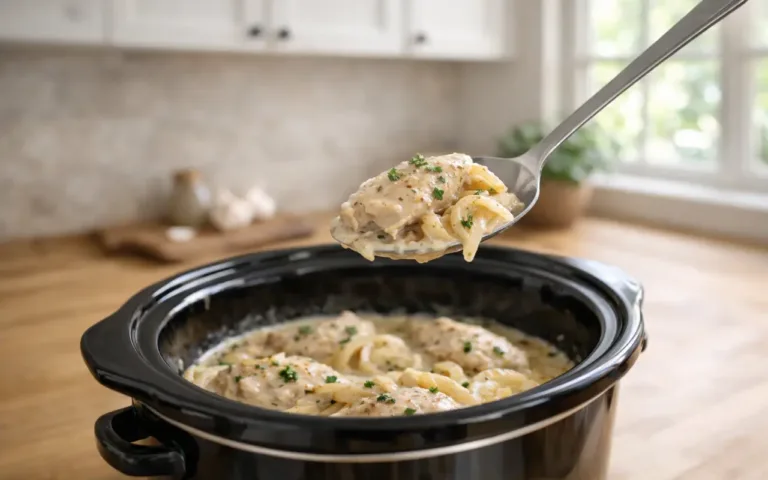
TECHNIQUE BRIEF
The technique is a liquid-first, temperature-cued slow-cooker build for frozen chicken. It controls three variables: heat transfer, moisture retention, and the timing window needed to reach a safe internal temperature. In home cooking, it’s most useful for shredded chicken, saucy chicken for bowls, and creamy chicken where you want low effort and predictable texture. Use it when you can keep chicken pieces separated and you can verify doneness with a thermometer. Avoid it when chicken is frozen into a solid block, when you can’t keep early heat stable, or when you can’t check internal temperature. Go straight to the Full Recipe Card if you only need the exact quantities and step order.
WHAT YOU NEED (Ingredients + Equipment)
INGREDIENTS (grouped by role)
Control base (required)
- Liquid: broth or water (improves heat transfer and prevents dry edges)
- Salt + black pepper (seasoning baseline)
Structure and body (for a sauce that coats)
- Onion + garlic (foundation flavor without extra cooking steps)
- Tomato paste (optional, quick body and savory depth)
- Cornstarch slurry (thickens without long reduction)
Creamy finish (added late)
- Cream cheese or plain Greek yogurt (choose one)
- Parmesan (optional, stirred in at the end)
Flavor-path options (choose 1 per cook)
- Salsa + lime (bright, bowl-friendly)
- Lemon + herbs (clean, mild)
- BBQ sauce (alcohol-free) + a little broth (sweet-savory)
Fast add-ins that behave well
- Frozen mixed vegetables (best added late)
- Beans (white beans hold shape)
- Spinach (stir in at the end)
Optional smoky add-on (serving only)
- turkey bacon bits (only if you want a smoky top note)
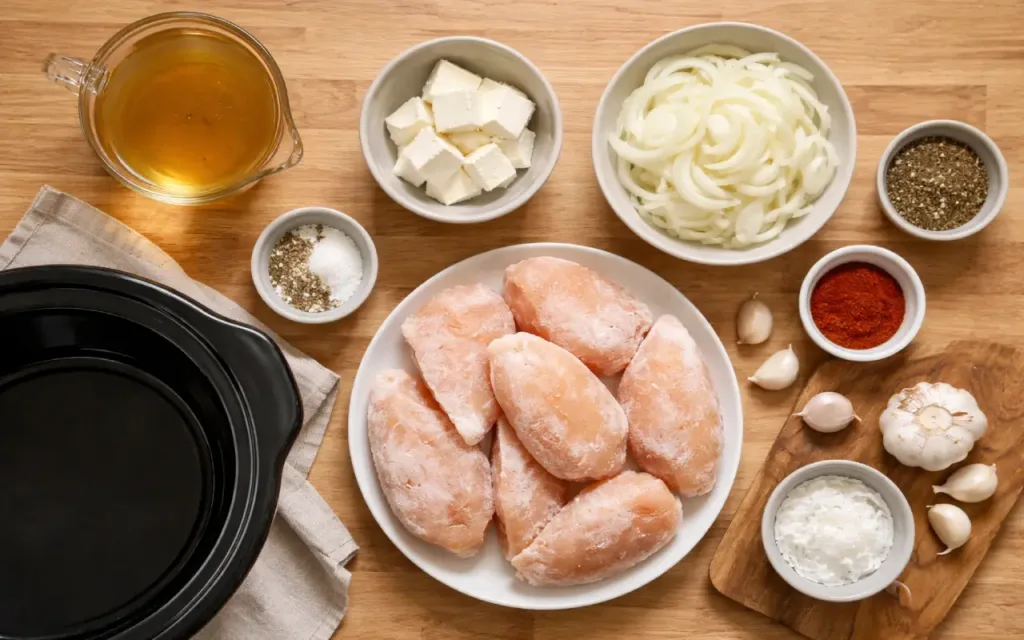
EQUIPMENT
Required
- Slow cooker (4–6 quart)
- Instant-read thermometer (this is the decision cue, not time)
Helpful
- Tongs (to separate pieces and flip if needed)
- Small whisk + bowl (for slurry)
- Shallow containers (cooling leftovers faster)
If you cook slow-cooker meals often, keep a rotation list under healthy dinner recipes crockpot.
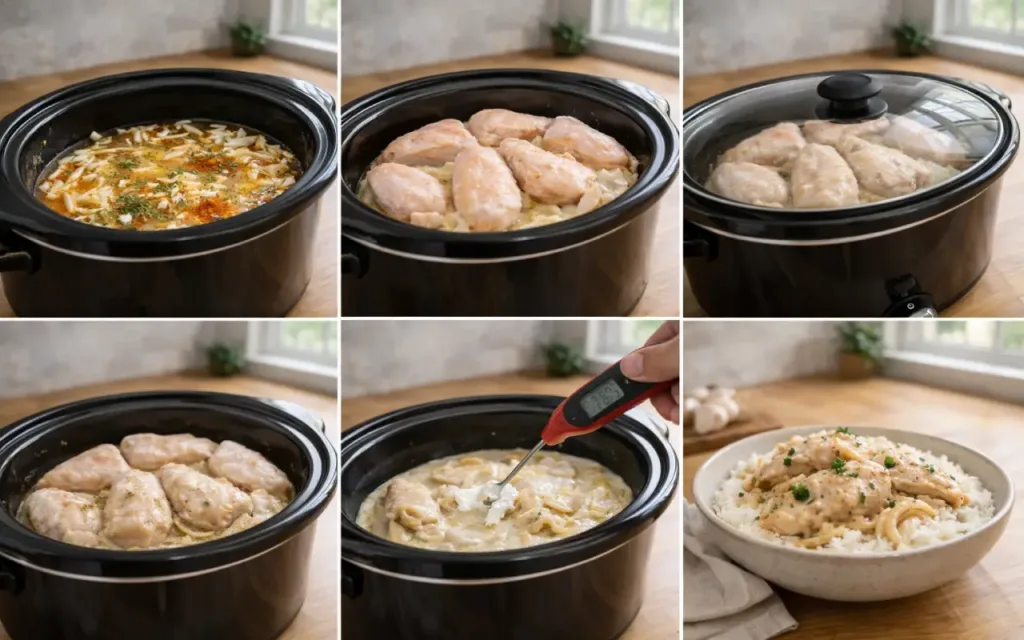
TECHNIQUE WALKTHROUGH (Cue-Based)
Frozen Chicken Crockpot Recipes: the control points
- Start with liquid already in the insert.
Cue: you should see a visible liquid layer before chicken goes in. Liquid helps heat reach the chicken evenly instead of relying on hot air pockets. - Add aromatics and baseline seasoning to the liquid first.
Cue: garlic/onion are sitting in the liquid, not piled on top of chicken. This builds a consistent sauce base while the chicken heats. - Add chicken only if pieces are separated.
Cue: pieces lie mostly flat, not fused into a thick block. A frozen block warms too slowly and unevenly in a slow cooker and reduces repeatability. (If the chicken is fused, thaw just enough to separate, then proceed.) - Use higher heat early, then maintain a steady cook.
Cue: within the first hour, the cooker should be clearly hot (steam and fully heated liquid). Avoid lid lifting because each lift drops temperature and extends the warming window. - Check doneness by temperature, not time.
Cue: the thickest part of the largest piece reaches 165°F / 74°C. If it’s not there, keep cooking and re-check later; cooker models and chicken thickness vary. - Stop cooking as soon as chicken is done.
Cue: chicken is fully cooked and still slices or shreds cleanly, not stringy. Overcooking is the main cause of dry slow-cooker chicken. - Finish creamy off strong heat.
Cue: simmering is gentle (or the cooker is on LOW/WARM), not bubbling hard. Add cream cheese or yogurt and stir until smooth, then thicken with slurry if needed. - Rest before shredding or slicing.
Cue: after 5–10 minutes, juices settle and texture improves. Shred for bowls/tacos or slice for plates.
ERRORS THAT DERAIL RESULTS
- Putting a solid frozen block into the slow cooker → heats too slowly and unevenly, which can create safety and texture problems. One reliable rule is to separate pieces first.
For the safety reasoning in plain terms, see Allrecipes’ warning about cooking frozen meat in a slow cooker. - Using “hours cooked” as the only cue → timing varies by cooker and thickness, so results swing from under-done to dry.
- Too little liquid at the start → edges dry out while the center lags; sauce can’t recover later.
- Adding dairy while the cooker is very hot → sauce can look grainy or split; creamy finishes want gentle heat.
- Repeated lid lifting → drops temperature and stretches cook time, making frozen starts less predictable.
THE MECHANICS BEHIND IT
- Controlling early heat causes faster warming, which reduces timing uncertainty and improves repeatability.
- Controlling moisture with a liquid-first base prevents dry surfaces, which produces tender shreddable chicken.
- Controlling thickness with slurry creates a coating sauce, which helps chicken stay moist during reheating.
- Controlling dairy timing prevents overheating, which keeps creamy sauces smooth instead of grainy.
- Controlling the “stop point” (doneness cue) prevents overcooking, which is the main driver of stringy texture.
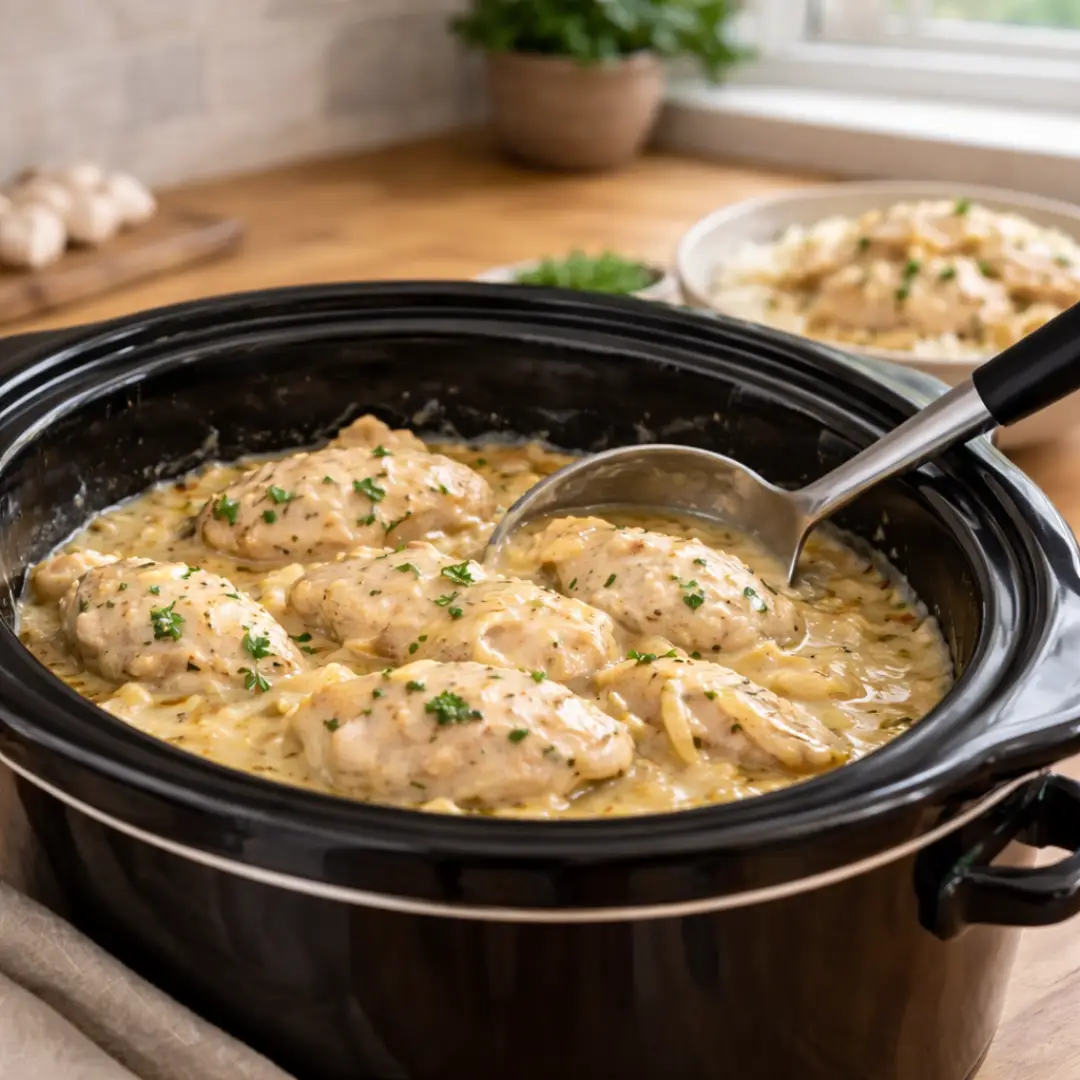
Creamy Garlic Crockpot Chicken (Frozen-Start Framework)
Equipment
- Slow cooker (4–6 qt)
- Instant-read thermometer
- Tongs or spoonV
- Small bowl + whisk (for slurry)
- Forks (for shredding)
Ingredients
Base method
- 2 lb chicken breasts or thighs use separated pieces
- 1 1/2 cups chicken broth
- 1 small onion thinly sliced
- 6 cloves garlic minced
- 1 1/2 tsp kosher salt divided
- 1/2 tsp black pepper
- 1 tsp paprika
- 1 tsp Italian seasoning
- 4 oz cream cheese or 3/4 cup plain Greek yogurt
- 1 tbsp cornstarch + 2 tbsp cold water slurry
- Optional: chopped parsley
- Optional topping: turkey bacon bits add at serving only
Flavor Path A: Salsa-Lime (optional)
- 1 cup salsa replace 1 cup broth
- 1 –2 tbsp lime juice finish
Flavor Path B: Lemon-Herb (optional)
- 1 tsp lemon zest finish
- 1 –2 tbsp lemon juice finish
Flavor Path C: BBQ-Style (optional)
- 3/4 cup BBQ sauce stir in after chicken is cooked
Instructions
- Add broth, onion, garlic, 1 tsp salt, pepper, paprika, and Italian seasoning to the slow cooker. Stir.
- Add chicken in a single layer as much as possible.
- Cook on HIGH for 1 hour, then continue on LOW until chicken reaches 165°F in the thickest piece.
- Typical timing after the first hour: 2–3 more hours on LOW (varies by cooker and thickness).
- Transfer chicken to a plate. Whisk cornstarch with cold water and stir into the hot liquid in the cooker.
- Reduce heat to LOW (or briefly turn off). Add cream cheese and stir until smooth (or stir in Greek yogurt gently).
- Return chicken to the sauce. Rest 5 minutes, then shred or slice.
- Choose ONE flavor path (optional):
- Salsa-Lime: stir salsa into sauce and finish with lime juice.
- Lemon-Herb: finish with lemon zest + lemon juice.
- BBQ-Style: stir in BBQ sauce and warm gently.
Notes
- If chicken was frozen together, thaw just enough to separate pieces before slow cooking.
- Don’t boil after adding dairy; gentle heat keeps the sauce smooth.
WHERE ELSE TO USE THIS
- Shredded chicken for tacos and rice bowls
Use the same base method, then choose Salsa-Lime at the end. Key cue: chicken shreds easily and sauce coats strands instead of pooling. - Creamy chicken for pasta
Slice chicken instead of shredding, and keep sauce slightly thinner (add a splash of broth before serving). Key cue: sauce clings to a spoon in a thin glossy layer. - Chicken-and-veg meal prep
Add frozen vegetables during the last 20–30 minutes so they don’t turn mushy. Key cue: vegetables are hot and tender but still hold shape. For a comfort-style slow cooker spin, see chicken soup pot pie in slow cooker. - Sandwich filling (mild lemon-herb)
Finish with Lemon-Herb and shred, then use in rolls with crunchy slaw added at serving. Key cue: filling stays moist without being watery.
Pick one application and follow the base method; stacking changes makes the technique harder to control.
HOLDING, REHEATING, AND MAKE-AHEAD
Storage window: refrigerate cooked chicken in airtight containers for 3–4 days. Store chicken with sauce so it stays moist.
Best reheat method: stovetop on low with a splash of broth. Gentle heat preserves texture and prevents the creamy sauce from tightening too fast.
What fails and why: high-heat microwaving can push chicken toward stringy texture, and it can make creamy sauces thicken unevenly. If you microwave, use medium power and stir halfway.
Make-ahead that doesn’t break control points:
- Pre-measure spices into a small cup.
- Slice onion and mince garlic ahead.
- Pre-mix slurry in a jar (cornstarch + water) and shake right before using.
- Keep dairy separate until the finishing step.
FINAL PRECISION NOTE
For Frozen Chicken Crockpot Recipes, the safest and most repeatable approach is: separated pieces + liquid-first base + thermometer cue to 165°F. Starting with a solid frozen block is where both safety and texture become unpredictable, so treat “separate first” as the hard rule and “time” as a soft estimate.
Final practical tip
If your slow cooker runs hot, shorten the LOW phase and check temperature earlier; if it runs cool, extend cooking but keep the lid closed. One early thermometer check is faster than guessing and prevents the most common outcome: chicken that’s technically done but overcooked and dry.
FAQ
Is it safe to cook chicken from frozen in a crockpot?
Many food-safety sources recommend thawing first because slow cookers heat slowly. If you proceed, only use separated pieces, start with liquid, and verify 165°F with a thermometer.
Why did my slow-cooker chicken turn dry even with liquid?
It usually cooked past the stop point. Pull at 165°F, then rest, and keep leftovers stored with sauce.
Can I use Greek yogurt instead of cream cheese?
Yes. Stir it in on LOW (or after turning the cooker off briefly) and avoid bubbling heat to keep it smooth.
When should I add vegetables?
Add quick-cooking frozen vegetables near the end so they hold shape. Long cooking turns many vegetables soft and watery.