
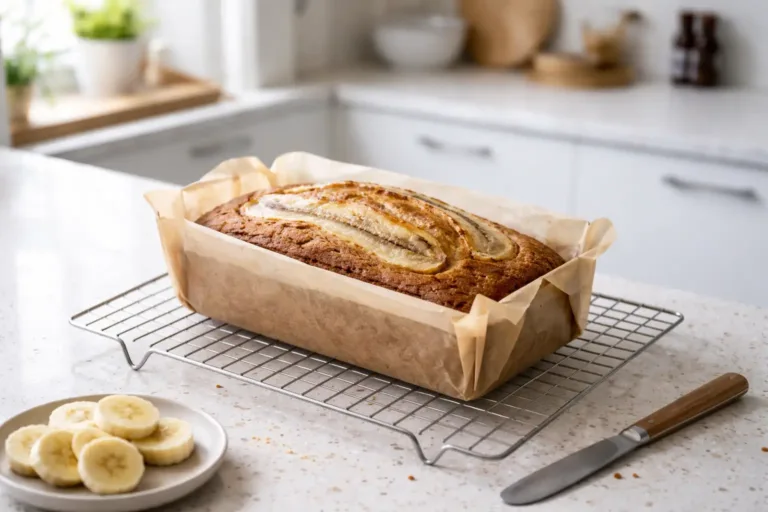
If you’re learning How To Make Banana Bread, this one-bowl method focuses on the few steps that actually control texture: ripe banana cues, gentle mixing, and a clear bake test. The batter comes together in minutes with pantry basics, and it bakes into a loaf with a tender crumb rather than a dense, gummy center. It’s most useful when you need a reliable bake for breakfasts, snacks, or a simple dessert that holds up for a few days. Expect a mild banana flavor with a soft slice and a lightly browned crust. If you want the full measurements and steps, go straight to the Recipe Card below.
HOW TO MAKE BANANA BREAD: WHY THIS RECIPE WORKS
- Ripe banana moisture + sweetness: Very ripe bananas provide natural sweetness and enough moisture so the loaf doesn’t rely on extra liquid.
- One-bowl mixing controls gluten: Flour is folded in gently at the end, which limits gluten development and keeps slices tender.
- Baking soda timing matches banana acidity: Baking soda reacts well with ripe bananas and brown sugar, helping lift without a dry, cakey texture.
- Clear doneness cues prevent gummy centers: A clean tester and a fully set center stop underbaking—the most common banana bread issue.
- For a comparable classic method to cross-check ratios and bake time, see King Arthur Baking’s Banana Bread recipe.
INGREDIENTS OVERVIEW (no measurements)
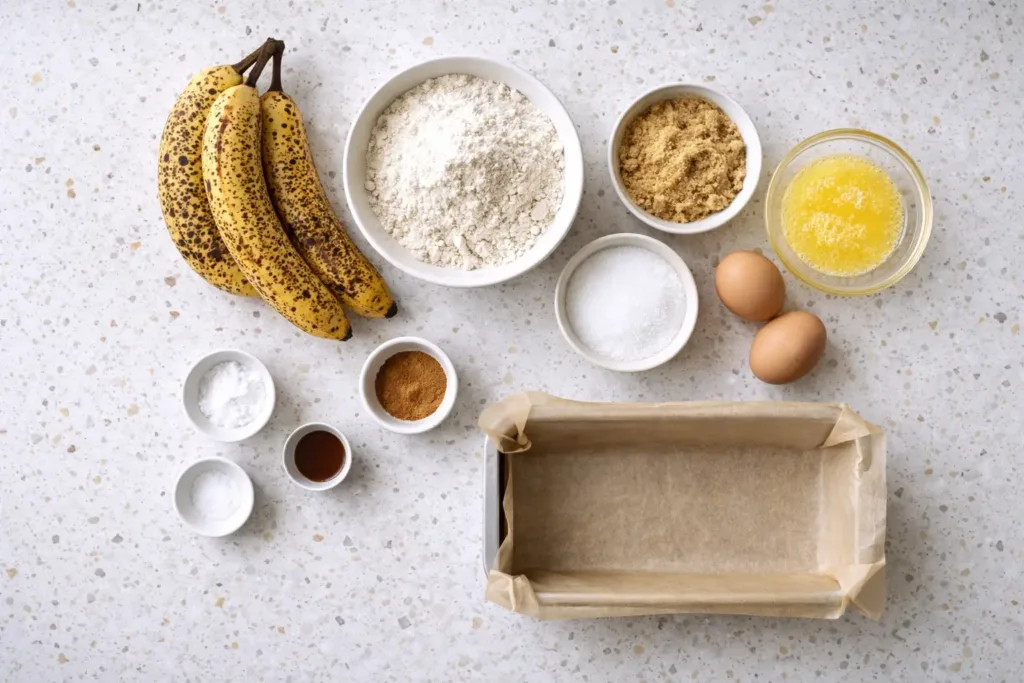
Core structure
- Ripe bananas (the riper, the better)
- All-purpose flour
- Baking soda + salt
Moisture + richness
- Melted butter (or neutral oil)
- Eggs
Sweetness + flavor
- Brown sugar (or mix of brown + white)
- Vanilla extract
- Cinnamon (optional)
Optional add-ins (keep reasonable so the loaf still sets)
- Chopped walnuts or pecans
- Chocolate chips
- A spoon of yogurt or sour cream (for extra tenderness)
HOW TO MAKE IT (HIGH-LEVEL FLOW)
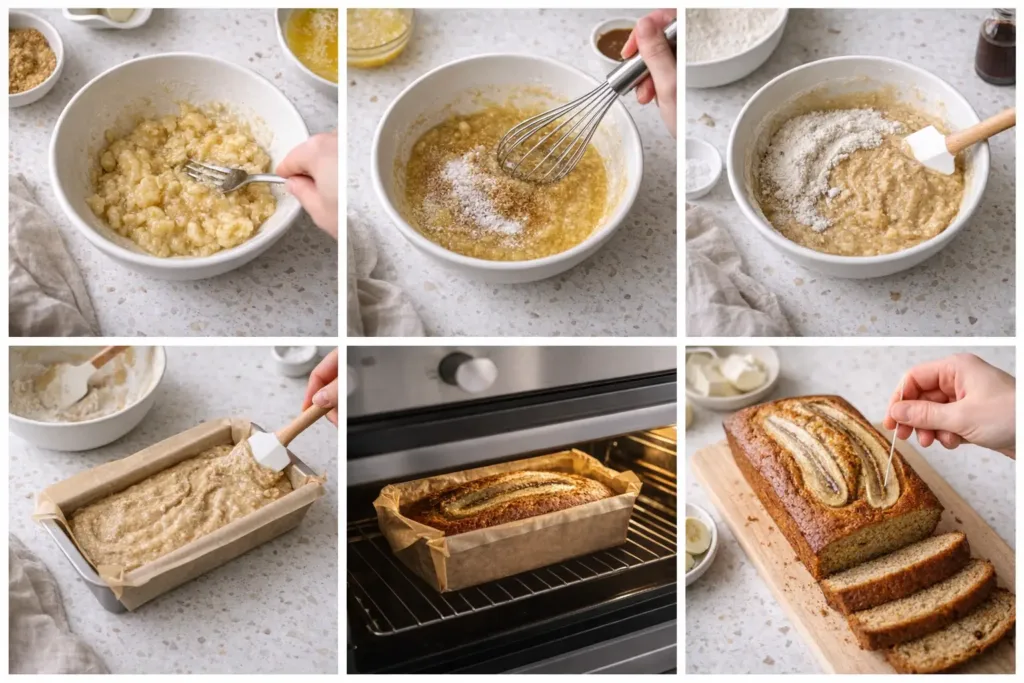
- Confirm ripeness: Use bananas that mash easily and smell sweet; heavy dark speckling is ideal.
- Mash + mix wet first: Mash bananas in the bowl, then whisk in sugar, melted butter, eggs, and vanilla until uniform.
- Add dry and fold: Sprinkle flour, baking soda, salt (and cinnamon if using) over the wet mixture and fold just until you stop seeing dry flour.
- Pan and bake: Pour into a greased or parchment-lined loaf pan and bake until the top is domed and set.
- Bake test: A toothpick should come out clean or with a few moist crumbs; wet batter means it needs more time.
- Cool before slicing: Cool in the pan briefly, then finish cooling on a rack so slices don’t compress and turn gummy.
RECIPE CARD Notes
- Ripe banana cue: If bananas are yellow with little spotting, the loaf usually bakes up less fragrant and less sweet.
- Don’t-overmix rule: Once flour is added, fold gently; overmixing makes a tight, bready crumb.
- Pan size matters: A standard 9×5-inch loaf pan bakes more evenly than a smaller pan that forces extra height.
- Add-ins limit: Too many chips/nuts can weigh down the center; keep add-ins moderate so the loaf sets.
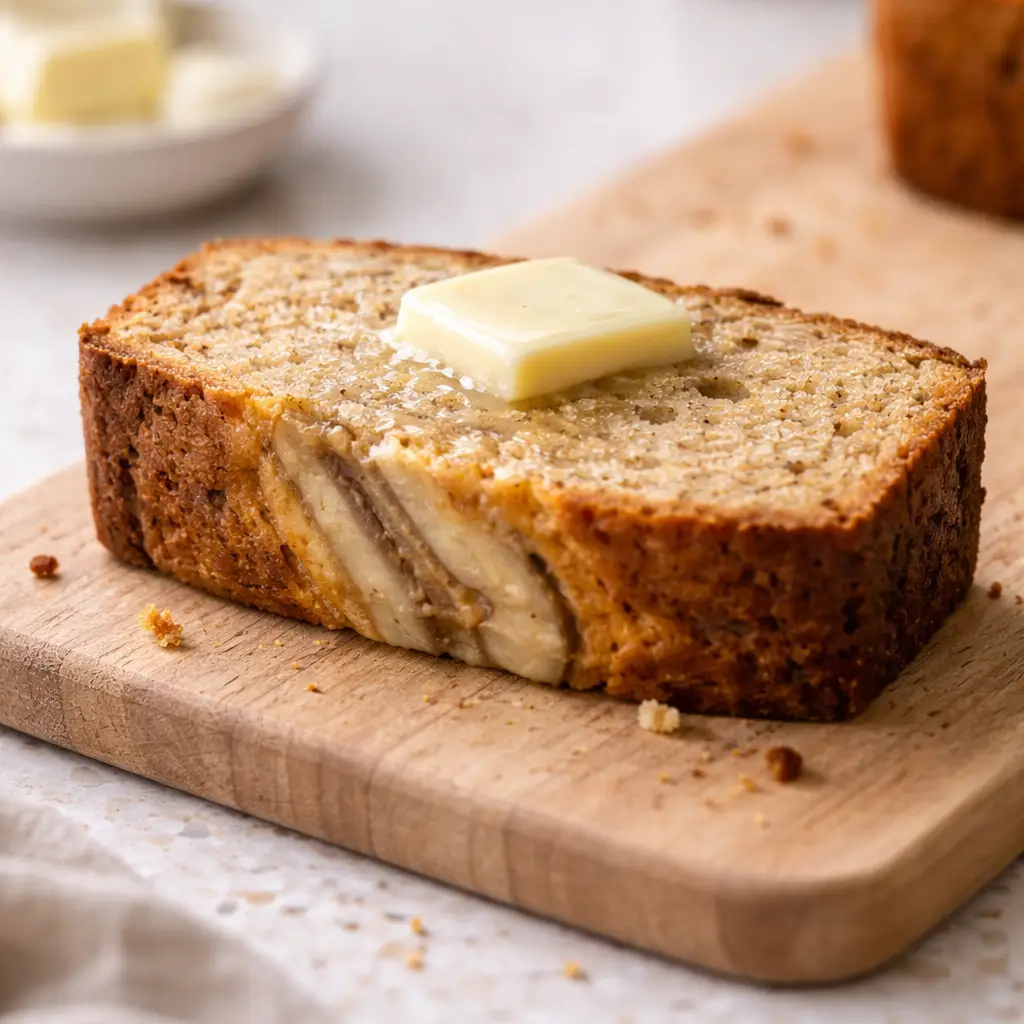
Classic Moist Banana Bread (1 Bowl, No Mixer)
Equipment
- 9×5-inch loaf pan
- Parchment paper (optional, for sling)
- Large mixing bowl
- Fork (for mashing)
- Whisk or sturdy spoon
- Rubber spatula
- Measuring cups and spoons
- Wire rack
- Toothpick or thin skewer (for doneness test)
Ingredients
- 3 very ripe bananas mashed (about 1 1/2 cups)
- 1/2 cup unsalted butter melted and slightly cooled
- 3/4 cup packed light brown sugar
- 2 large eggs
- 1 teaspoon vanilla extract
- 1 1/2 cups all-purpose flour
- 1 teaspoon baking soda
- 1/2 teaspoon fine salt
- 1 teaspoon ground cinnamon optional
- Optional add-ins choose up to 1 cup total
- 1/2 to 3/4 cup chocolate chips
- 1/2 cup chopped walnuts or pecans
Instructions
- Heat oven to 350°F (175°C). Grease a 9×5-inch loaf pan or line with parchment.
- In a large bowl, mash bananas until mostly smooth (a few small lumps are fine).
- Whisk in melted butter and brown sugar until glossy and well combined.
- Whisk in eggs and vanilla until the mixture looks uniform and slightly thick.
- Sprinkle flour, baking soda, salt, and cinnamon (if using) over the wet mixture. Fold with a spatula just until you no longer see dry flour. Stop early—a few streaks are better than overmixing.
- Fold in optional add-ins. Pour batter into the pan and level the top.
- Bake 50–60 minutes, until the top is domed and set and a toothpick inserted in the center comes out clean or with a few moist crumbs.
- If/then reliability line: If the top is browning fast but the center still tests wet, tent loosely with foil and keep baking in 5-minute checks.
- Cool in pan 10 minutes, then lift out and cool completely on a rack before slicing.
Notes
PRACTICAL VARIATIONS
- Change: Make it nutty (walnuts or pecans).
Method adjustment: Fold in at the end with minimal stirring.
Risk note: Too many add-ins can sink and weigh down the center; keep it moderate. - Change: Turn it into muffin-style bakes.
Method adjustment: Use the same batter, portion into a lined muffin tin, and bake until a tester comes out with moist crumbs.
Risk note: Overbaking muffins happens fast; start checking early. If you want another breakfast-friendly bake, try pumpkin cinnamon roll muffins. - Change: Extra-tender crumb with yogurt or sour cream.
Method adjustment: Add a few spoonfuls with the wet ingredients, then fold flour gently.
Risk note: Too much added dairy can make the loaf heavy; keep the addition small. - Change: Chocolate-banana loaf (chips + cocoa).
Method adjustment: Replace a small portion of flour with cocoa and add chips.
Risk note: Cocoa can dry the crumb if overbaked; use the toothpick cue and don’t push past “clean with a few crumbs.”
STORAGE & REHEATING
Store banana bread tightly wrapped or in an airtight container at room temperature for 2–3 days. For longer holding, refrigerate up to 5 days (wrap well to prevent drying), and bring slices to room temperature before eating for the best texture. A quick warm-up (10–15 seconds in the microwave) softens the crumb without making it tough; avoid overheating or it can turn rubbery. If you want another dessert that stores well for quick treats, bookmark apple brownies dessert bars.
Use the reheating method that matches the texture you want—this is the difference between leftovers that dry out and leftovers that hold up.
FINAL PRACTICAL TIP
Treat the bake test as a range, not a single moment: you want a toothpick that comes out clean or with a few moist crumbs, not wet batter. This small checkpoint prevents the most common “looks done, slices gummy” problem. Once you nail this cue, the recipe stays consistent even if your bananas are slightly larger or your oven runs a little hot.
FAQ
How To Make Banana Bread if my bananas aren’t ripe yet?
Let them ripen at room temperature until heavily speckled and fragrant; baking with underripe bananas usually produces a bland, drier loaf.
Why did my loaf sink in the middle?
Most often it was underbaked in the center or overmixed, which weakens structure. Use the clean-tester cue and fold flour gently.
Can I freeze banana bread?
Yes. Wrap the fully cooled loaf (or individual slices) tightly and freeze. Thaw wrapped at room temperature so it doesn’t pick up freezer moisture.
What pan should I use?
A 9×5-inch loaf pan is the most predictable for bake time and doneness cues. Smaller pans often cause underbaked centers.